Signs Your Goat Is About to Give Birth (and What to Do)
Few things are more exciting (and nerve-wracking) than goat kidding season. One minute your doe is happily munching hay, and the next she’s giving you side-eye like, “Human, grab the towels — it’s happening.”
If you’ve ever found yourself standing in the barn in the middle of the night asking a goat, “Are you actually doing this, or are you just messing with me?” — you’re not alone.
Kidding season is unpredictable, exhausting, and full of second-guessing. Goats don’t read calendars, they don’t follow timelines, and they are very good at convincing you something is happening when absolutely nothing is.
Understanding the signs of labor helps — but knowing how to interpret them realistically is what keeps you from losing your sanity.
The good news? Goats usually know what they’re doing.
The Countdown to Kidding
First Things First: Goat Due Dates Are Suggestions, Not Deadlines
A goat’s average gestation is about 150 days, but anywhere from 145 to 155 days is considered normal. I have had goats go 160+ days… trust me… at that point, she has you second guessing if she is really pregnant.
A due date doesn’t tell you when a goat will kid. It simply gives you a time frame to start watching that specific doe more closely and waiting for signs.
Some goats will deliver early and quietly. Some will go well past their due dates acting completely normal. Others will convince you they are in labor for days — sometimes weeks — before doing anything at all.
As you spend more time with your goats, the signs do get easier to interpret. You learn each doe’s habits, personality, and patterns. Even then, they still have the ability to keep you guessing and checking the barn constantly.
Experience helps, but it doesn’t eliminate surprises.
Early Signs That Might Mean Labor Is Coming
These are the signs that often cause false alarms. They’re worth watching, but they don’t always mean labor is imminent.
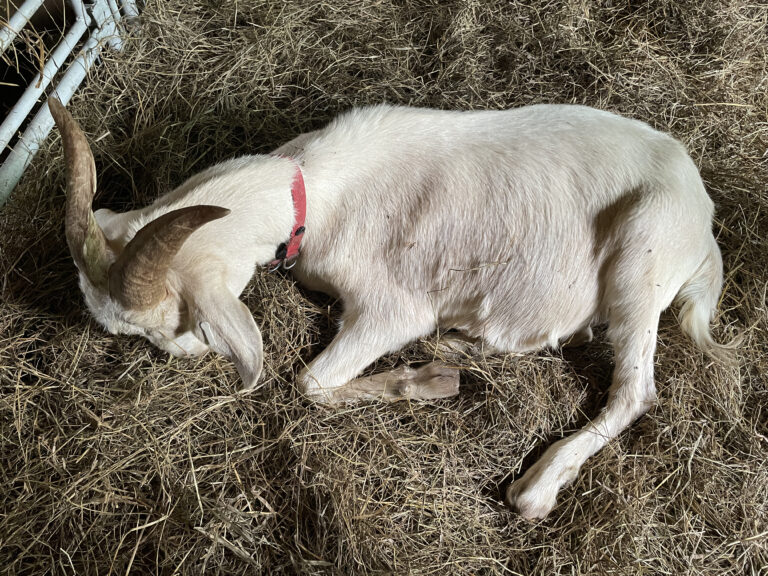
Restlessness, Getting Up and Down, and Pawing at Bedding
Many does start labor by:
- Getting up and laying back down repeatedly
- Pawing or nesting in the bedding
- Shifting positions often
This behavior can last much longer than you would expect or want. Early on, it may happen occasionally. As labor gets closer, it usually becomes more frequent and more deliberate.
If the behavior is increasing instead of fading out, that’s more meaningful than a single restless evening.
Vocalizing, Groaning, or Complaining
Some goats are very vocal during labor. They may groan, grunt, or make low, uncomfortable sounds that clearly signal something is happening.
However, this is not a sign you should rely on. Some does will not make a sound at all — even when actively pushing. Silent labor is more common than people expect, especially in experienced mothers.
Waiting for noise before checking the barn is how people miss births.
Separating From the Herd
As labor approaches, many does will move off by themselves. They may stand alone, face a wall, or choose a quiet corner away from the rest of the herd.
This is a natural instinct. They are trying to avoid being bothered by nosy neighbors and want privacy to deliver. When a normally social goat suddenly wants space, it’s often worth paying attention.
Loss of Appetite (Usually)
Most does lose their appetite as labor approaches. A goat that normally rushes to the feeder but suddenly ignores grain can be a strong indicator that things are progressing.
That said, there are exceptions. We’ve had mommas stop mid-labor to grab a snack between contractions and then get right back to business.
Loss of appetite is common, but eating does not automatically mean labor isn’t close.
Signs That Labor Is Likely Getting Close
When several of these signs appear together, you’re often looking at hours rather than days.
Udder Changes and Bagging Up
A doe’s udder may:
- Become noticeably larger
- Feel tighter or shinier
- Look fuller than usual
First-time moms often bag up later than experienced does, sometimes very close to delivery. Sudden changes matter more than gradual ones.
Vulva Changes and the Mucus Plug
As kidding approaches, you may see swelling and elongation of the vulva along with discharge.
This is not the thin white mucus that can appear up to a month before kidding. What you’re watching for is the mucus plug — often a thick, clear or cloudy string of goo hanging out.
When this type of discharge appears along with other signs, things are usually going to start moving very soon.
Ligament Softening Near the Tail Head
The ligaments on either side of the tail head soften as labor approaches. This is one of the most helpful signs, but also one of the easiest to misinterpret.
It helps to get familiar with how the ligaments feel on each individual doe. They feel different on a first freshener than on a seasoned momma, and not every goat softens the same way.
Because of this, checking ligaments regularly throughout pregnancy gives you a better baseline and makes it easier to recognize real change when labor is actually close.
Behavioral Shift
Right before labor, many does become quieter and more focused. They may seem distant, stop interacting, or repeatedly lie down and get back up.
This calm, inward-focused behavior often shows up shortly before active labor begins.
Sometimes There Are No Signs at All
Some goats:
- Eat breakfast like nothing is happening
- Act completely normal
- Deliver kids quietly while you aren’t looking
These are the goats that remind us that no system is foolproof. Checking frequently is often the only reason people catch these births in progress.
What to Do When You Think Labor Is Close
Prepare the Kidding Area
Make sure the space is:
- Clean and dry
- Quiet and low stress
- Well-bedded with fresh straw
- Stocked with fresh water
Have a Kidding Kit Ready
Do this before you need it. Include:
- Clean towels
- Disposable gloves
- Lubricant
- Iodine for navels
- A flashlight or headlamp
- A charged phone
Check Regularly, But Don’t Hover
Frequent checks are helpful. Constant hovering can slow things down. Goats often prefer privacy, but they still benefit from you being nearby and attentive.
What to Do (and What Not to Do)
Do:
- Have your kidding kit ready (towels, gloves, iodine, scissors, flashlight).
- Watch quietly from a distance unless she needs help.
- Make sure kids start breathing and nursing quickly.
Don’t:
- Panic. (Easier said than done.)
- Jump in too early. Most goat births go just fine without intervention.
- Forget snacks and coffee for yourself — kidding can take a while.
When to Be Concerned
Reach out to an experienced goat mentor or veterinarian if:
- A doe has been actively pushing for 30 minutes or more with no progress
- A water bag breaks and nothing follows
- You see presentation that isn’t nose and front feet
- The doe seems weak, distressed, or is bleeding excessively
Trust your instincts. It’s better to ask early than wait too long.
Crazy Goat Lady Tip
Goats like to keep you guessing. Many will kid at 2 a.m. when you’ve just fallen asleep. Others will wait until you’re at work. If you’re convinced “today’s the day,” she’ll probably hold out just to mess with you.
Final Thoughts
Kidding season is equal parts thrilling, messy, and magical. Knowing the signs helps you prepare, but remember — your doe’s body knows what to do. You’re just the assistant on call.
Goat labor is rarely predictable. Due dates give you a starting point. Signs take time and experience to interpret. Even seasoned goat owners still get fooled.
Pay attention to patterns, not just individual signs. Most goats know what they’re doing — and most births go just fine — but staying observant and prepared makes all the difference.
You’ll lose sleep. You’ll question yourself. And then one morning you’ll walk into the barn and see tiny hooves and wobbling legs, and suddenly all of it will feel worth it.
Want my complete “Goat Kidding Kit” checklist? Grab it free here: